Title
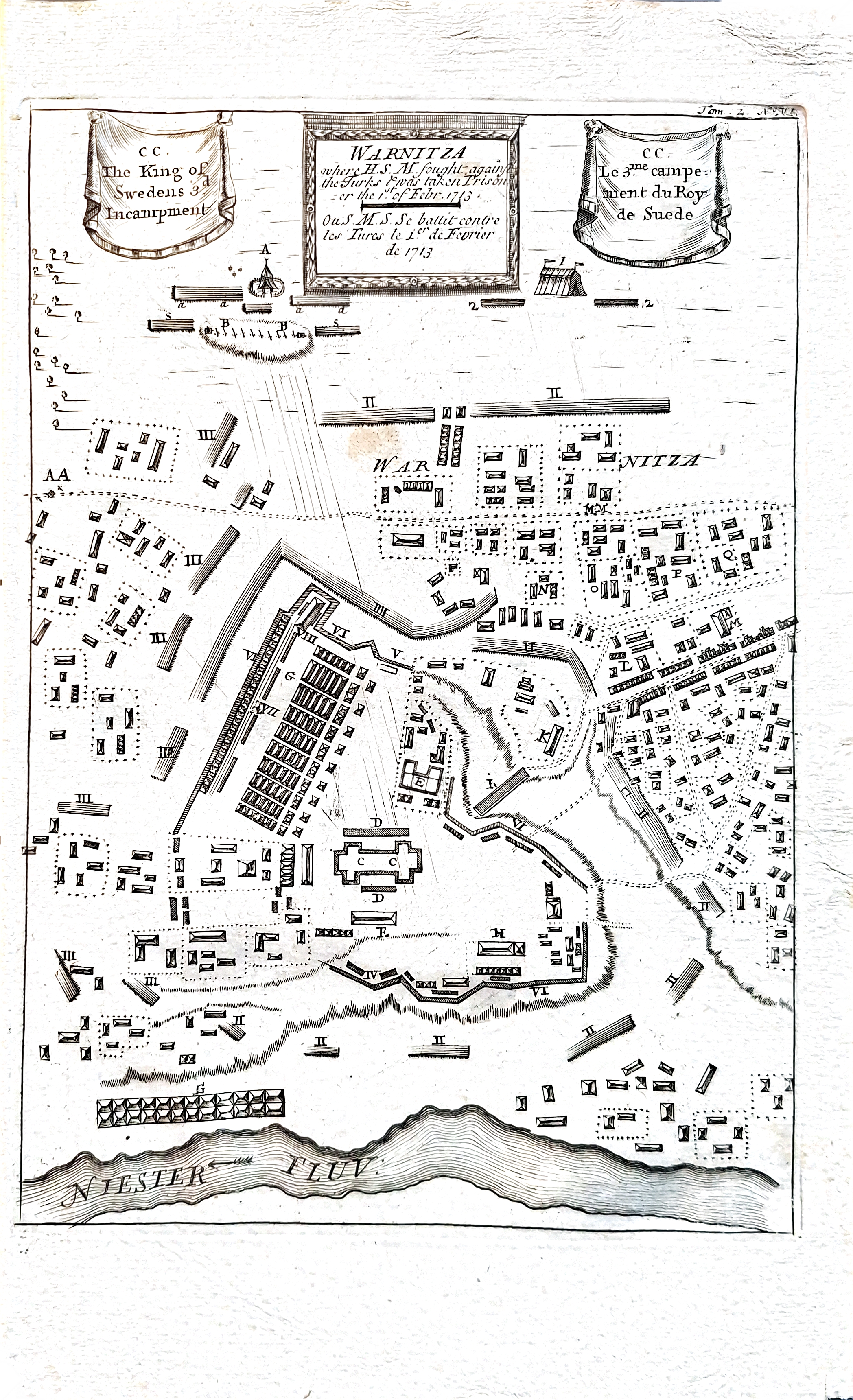
Warnitza where H.S.M. fought against the Turks & was taken Prisonzer the 1st of Febr. 1713 = Ou S. M. Se battit contre les Turcs le 1er de Fevrier de 1713.
Description
Striking and highly detailed fine unusual copper engraved map and a view of Battle of Varnita, Moldova.
Varnița is a village in the Anenii Noi District, in south-eastern Moldova, located near Bender (Tighina). It is also considered a suburb of Bender.
The first mention of the village comes from the company of Sultan Suleiman the Magnificent in a firman directed to Hasan, a bey of Akkerman and the Sandžak. It mentions that according to information provided by Moldovan voivode Alexandru Lăpușneanu, bandits who had committed murders and robberies had found shelter in Varnița or Varnigea near Bender. There is a hypothesis according to which the town was established immediately after the creation of Bender in 1538.
After losing the battle of Poltava, Swedish King Charles XII lived in the village in 1709–1713. The king set up a military camp in here which was called the Second Stockholm. The settlement included his Cossack and Moldavian allies, notably among whom was Ivan Mazepa, who died in Varnița. In 1925, at the request of the Swedish authorities, a memorial obelisk was erected here. A separate monument commemorates the figure of Mazepa.
In 2016, the remains of the palace of Charles XII were found in the village.
Source: Aubry de la Mottraye. Voyages du S.r A. de La Motraye, en Europe, Asie & Afrique. Où l’on trouve une grande varieté de Recherches géographiques, historiques & politiques…, vols Ι-ΙΙ, The Hague, T. Johnson & J. van Duren, 1727.
Aubry de la Mottraye (1674?-1743) came from a French Huguenot family that had settled in England. He received an excellent education, and started travelling in 1696. In the course of twenty-six years, he toured Northern Europe, Crimea, the Near East, Russia, Prussia and Poland. La Mottraye combined diplomatic travels – as counsellor and attendant to various rulers – with commercial transactions and his activity as a collector.
His chronicle is adorned with impressive engravings of rare subjects, views of cities as well as everyday life scenes. His detailed descriptions make his account one of the first travelogues in which the force of the written discourse equals the impact of the illustrations. To this day, his diary notes in the page margins remain invaluable to researchers.
On his first journey, in 1696, La Mottraye travelled from Paris to Rome, Alexandria and Lisbon, to end up in England. On his second trip, he sailed on a British ship from Gravesend to Smyrna in 1698, and reached the Aegean archipelago by way of Gibraltar. He landed on Patmos on the boat that provided the ship with fish. He crossed over to Clazomenae and arrived at Smyrna, where he stayed for five months. La Mottraye describes the city, English commerce in the area, the grave of Saint Polycarpus, the vines on the outskirts of the city, and mentions the earthquake of 1688. He visited Ephesus in February 1699. He also toured Chios, and wrote about the mastic and the fragrances of the island. He stayed in Samos for three days and visited the ruins of Hera’s temple. A regular seeker of ancient coins, on leaving Smyrna at the end of May 1699, he obtained numerous specimens from Lesbos and the harbours of the Hellespont.
In the section on Constantinople, La Mottraye expands on various aspects of the city, touching on such diverse subjects as current political events and diplomatic relations between the Sultan and foreign ambassadors, the port, the fleet, the impressive kiosks, Chalcedon, Hagia Sophia, the mosques, the palace, the harem, the audiences of the Sultan, the Byzantine hippodrome, the historical columns, the cemeteries of Greeks, Armenians and Jews, a Turkish wedding, dervishes, “bedestens”, inns and Ramadan. He describes at length the impressive entrance procession of the Sultan escorted by hundreds of officials and servants of his court.
Mottraye visited Nicomedia and stayed in Bursa till 1703. In April of that year he travelled to Ankara (he provides information on Greek inscriptions, the Greek bishop and the churches in that city), Sinope (where he bought several ancient coins) and Amastris, from where he entered the Bosporus. In July 1703, La Mottraye was an eyewitness to the events in Adrianople, in which Sultan Mustafa II, who was inclined towards reforming the Empire and attempted to regulate its internal affairs after the Treaty of Carlowitz (1699), lost his throne. He also writes about the Greek Patriarch and the patriarchal church. In June 1707, La Mottraye embarked on a small ship carrying citrus fruits from Chios and travelled to Smyrna again, where he stayed for three weeks. From there he sailed via Naxos to Santorini, spending three days there. Then, by way of Amorgos, Naxos and Andros, he arrived in Thessalonica. He visited Mount Athos for two days, as well as Aenus and Adrianople, where the Greek wedding he describes took place, and returned to Constantinople.
Until 1710, the year of his final departure from the East, La Mottraye continued his travels from the capital of the Ottoman Empire, reaching as far as Malta and Barcelona. Among other places, he stopped at Lesbos, the Thracian cities in the Hellespont, Tenedos, Lemnos, Troy, Psara, the islands of the Aegean, Monemvasia, Crete, Zacynthos and elsewhere. He was always recording the political events of the time, and never abandoned his quest for and purchase of antiquities, mainly ancient coins.
In 1713, after numerous journeys to Northern Europe, La Mottraye went again to Constantinople. Crossing Eastern Thrace and Adrianople, he continued on to Philippoupolis (Plovdiv), Sofia and Belgrade. From this last city he journeyed to Vienna, the Netherlands and finally to England. In 1714 he returned to Constantinople once more, travelling through Germany, Hungary and the east coast of the Black Sea.
Date
1727 ( undated )
Dimension
Paper size approx.: cm 19.3 x 31.4
Mapmaker:
Aubry de La Mottraye (c. 1674 – Paris, 1743) was a French writer and traveler.
Aubry’s family moved to England due to religious persecution in France. The young man received a good education and in 1696 began traveling, exploring Northern Europe, Crimea, the Near East, Russia, Prussia, and Poland.
On his first voyage, he traveled from Paris to Rome, Alexandria to Lisbon, and then back to England. He later sailed from Gravesend to Smyrna, intending to visit the Aegean islands.
He wrote numerous accounts of his travels, describing cities, natural sites, and episodes of daily life in detail. He visited Nicomedia, remained in Bursa until 1703, and in Malta and Barcelona until 1710, departing from Constantinople. After a series of journeys through Northern Europe, he returned to Constantinople.