Title
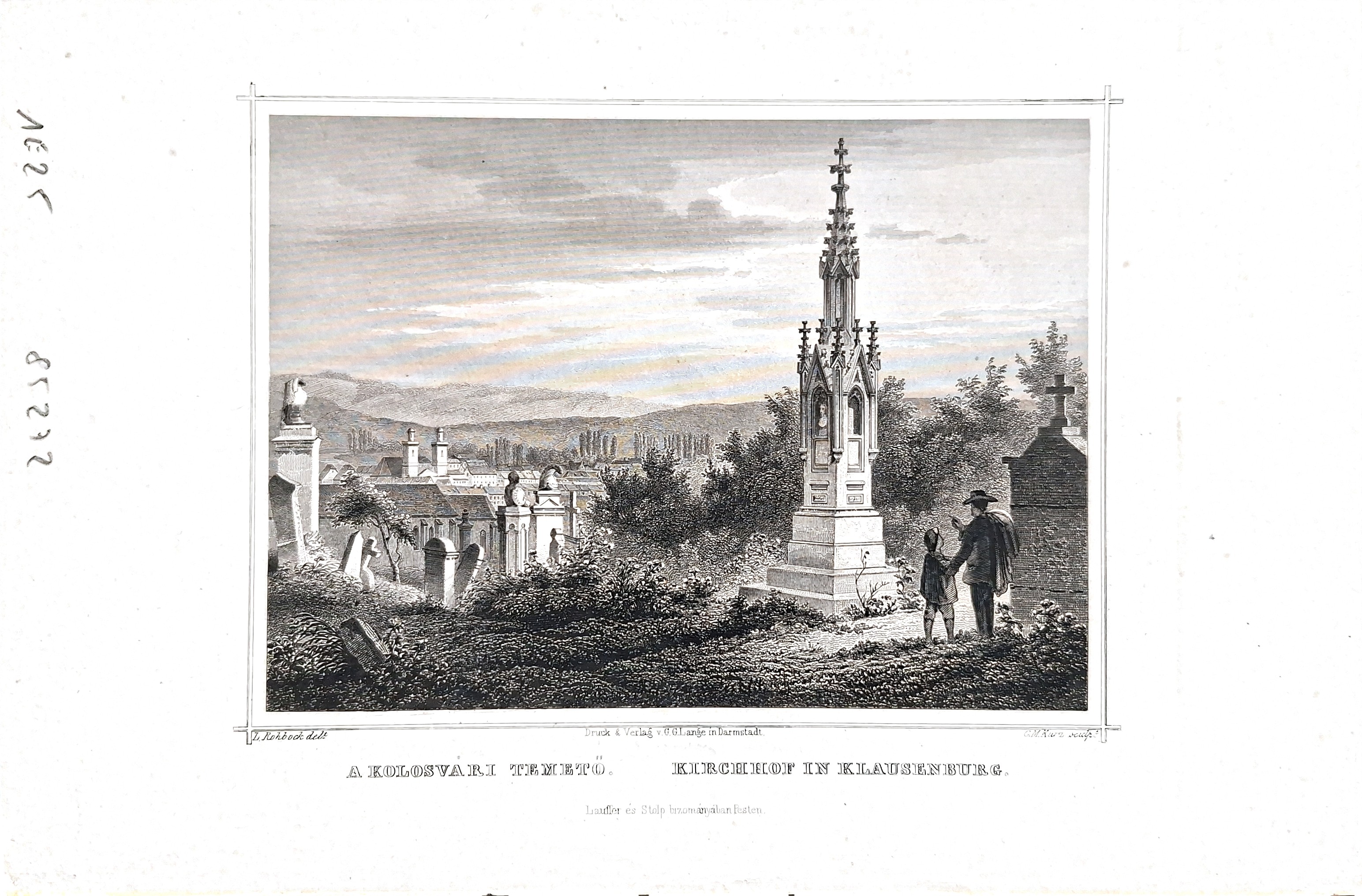
Rohbock - Cluj-Napoca, Klausenburg - 1864
Description
Old lithography signed by Ludwig Rohbock and Georg Michael Kurz and included in “Ungarn und Siebenbürgen in malerischen Original-Ansichten”, Gustav Georg Lange, Darmstadt 1863-1864. The picture shows the Hajongard Cemetery (Cimitirul Central) from Klausenburg now Cluj-Napoca, one of the oldest and most culturally significant cemeteries in South-Eastern Europe. Here is a list of the most visited and famous graves, grouped by their impact on history and culture.
Writers and Artists
Miklós Bánffy (1873–1950): A polymath known as a writer, illustrator, and diplomat. He is the author of the famous Transylvanian Trilogy and lived in the Bánffy Palace.
Ion Agârbiceanu (1882–1963): A prolific Romanian writer and priest, he was a member of the Romanian Academy and a prominent figure in the local Greek-Catholic community.
Jenő Janovics (1872–1945): A pioneer of European cinema and director of the National Theatre in Cluj, he was instrumental in establishing the city as an early film production hub.
Jenő Dsida (1907–1938): A beloved Hungarian poet and translator who spent much of his life in Cluj.
Scientists and Scholars
Emil Racoviță (1868–1947): A world-renowned biologist and polar explorer who participated in the Belgica Antarctic expedition. He founded the world’s first Institute of Speleology in Cluj.
János Apáczai Csere (1625–1659): A famous mathematician and humanist who wrote the first Hungarian encyclopedia.
Sámuel Brassai (1797–1897): Known as the “Last Transylvanian Polymath,” he was a linguist, musician, and teacher whose tomb is a central landmark.
Iuliu Hațieganu (1885–1959): A famous physician and the founder of the modern medical school in Cluj, the University of Medicine and Pharmacy
Nobility and Historic Vaults
The Bethlen Family Tomb: This is particularly notable as the only Neo-Roman style funerary monument in the entire county.
Aristocratic Vaults: You will find impressive mausoleums for several noble families including the Teleki, Apor, and Kendeffy families, reflecting the city’s 18th and 19th-century elite.
Political and Human Rights Figures
Doina Cornea (1929–2018): A prominent anti-communist dissident and human rights activist who lived in Cluj during the Cold War.
Constantin Daicoviciu (1898–1973): A significant historian and archaeologist who served as the rector of the local university.
Rohbock’s engravings are characterized by:
- Topographic Precision: He captured the specific layout of the cemetery, including its characteristic funerary monuments and the surrounding landscape of Cluj-Napoca
- Romantic Atmosphere: Like his other works, he often included small human figures to provide scale and a sense of daily life or contemplation.
Date
1864 ( undated )
Dimension
Picture size approx.: 11 x 16 cm
Author:
Ludwig Rohbock (1824–1893) was a German artist, renowed for his detailed ararchitectural and landscape depictions across Central Europe.