Title
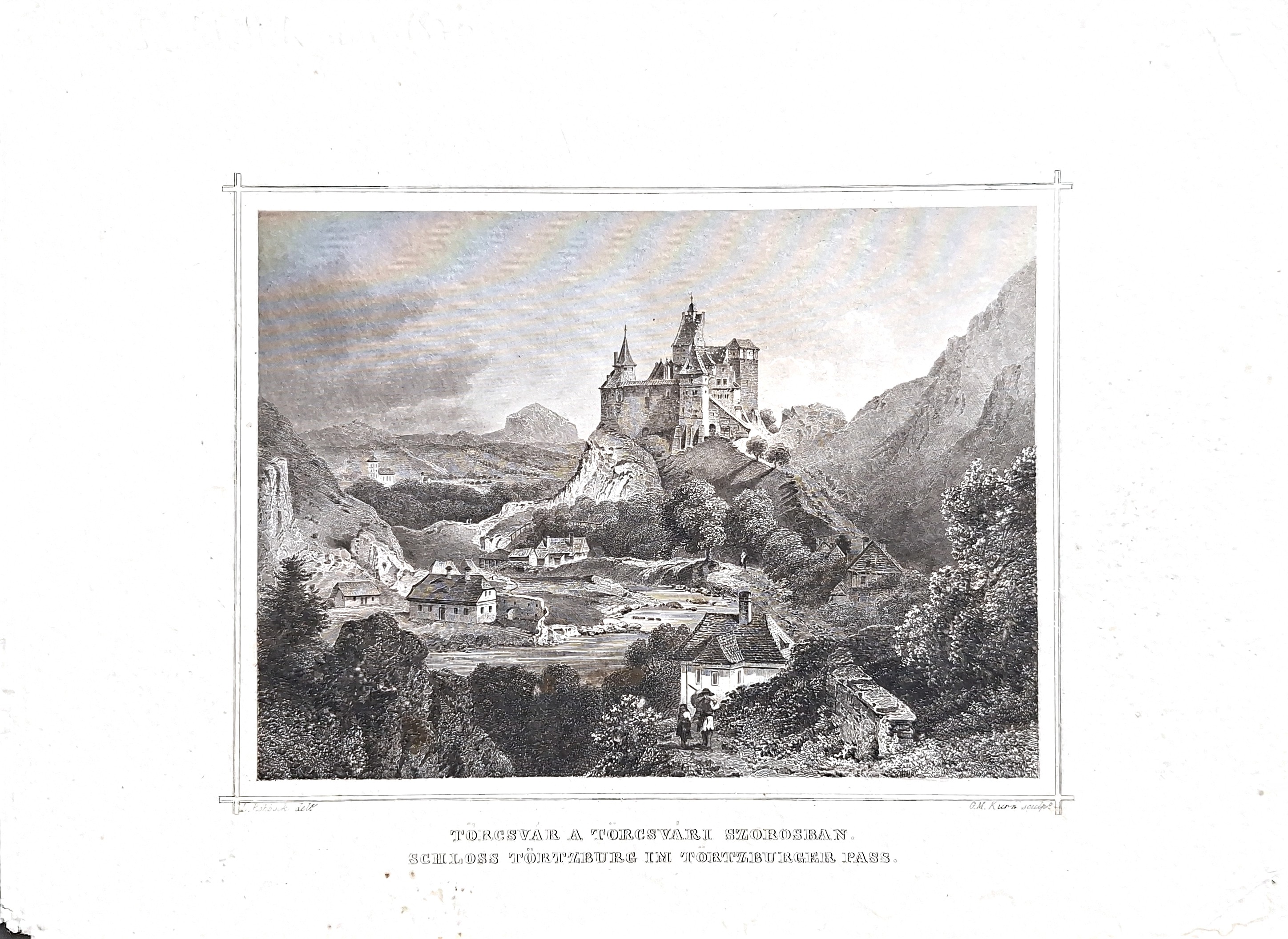
Rohbock - Bran, Tortzburg Castle - 1864
Description
Old steel engraving signed by Ludwig Rohbock and Georg Michael Kurz, included in the historic work ‘Ungarn und Siebenbürgen in malerischen Original-Ansichten’, published by Gustav Georg Lange (Darmstadt, 1863-1864) with accompanying texts by János Hunfalvy.
The engraving captures the Bran, Tortzburg Castle and depicts the fortress as a dramatic, solitary stronghold. It showcases the medieval castle perched high atop a steep, rocky cliff, surrounded by the lush, mountainous landscape of Transylvania.
Key Visual Details
The Fortress
The stone walls, irregular towers, and characteristic steep roofs of the castle stand out against the sky. The perspective highlights the castle’s dominance over the valley.
The Landscape
Below the castle walls, the rocky terrain slopes down into a wooded valley. In the distance, layers of majestic hills and mountains fade into the horizon.
The Setting
Small details, such as a winding path and sparse trees, are used to frame the composition. This grounds the grand architecture in the natural environment.
Compared to its appearance in Rohbock’s time (1864), today’s Bran Castle looks much more welcoming, inhabited, and refined, having transformed from a neglected military fortress into a fairytale royal residence. In the 19th century, the castle was managed by Austro-Hungarian forestry authorities and suffered from severe neglect, retaining a bleak, strictly defensive appearance.The major structural and environmental differences are the result of a massive restoration carried out between 1920 and 1932 by Queen Marie of Romania and the Czech architect Karel Liman:
- Transformation of the Inner Courtyard and Loggias
Then (1864): the courtyard was a sober, utilitarian stone space designed for military defense during sieges Now: The inner courtyard has been radically softened. The architects added timber-framed details (half-timbering), suspended terraces, romantic balconies, and elegant loggias with carved balustrades, giving it its current fairytale look.
- Roofs and Windows
Then (1864): The towers had simple roofs, partially damaged by centuries of harsh weather, and the windows were mostly small arrow slits. Now: The architecture was enriched with bright red ceramic tiled roofs of varying shapes and heights. Several arrow slits were enlarged into standard windows to let light into the new royal apartments.
- The Well and Elevator Tower
Then (1864): The courtyard featured only a deep, medieval stone well (about 18 meters deep) used strictly for water supply during sieges. Now: In the 1930s, the well shaft was converted into an elevator shaft. It connects via an underground tunnel directly to the park at the base of the cliff (known today as the Time Tunnel).
- The Surroundings and Royal Park
Then (1864): Rohbock’s engraving shows a steep, barren, and wild rock formation. At the base of the castle sat only the commercial border road and customs buildings. Now: The area around the cliff has been completely reshaped into a beautiful English park featuring paved walkways, two lakes, greenhouses, and famous annex buildings, such as the Queen’s Tea House.
- The Interior
Then (1864): The inner rooms were cold, with massive stone walls, used primarily as storage or garrison spaces. Now: The interior houses a museum spread across four floors. It is decorated with period furniture, restored fireplaces, wide arches, and art collections that reflect the interwar royal atmosphere.
Date
1864 ( undated )
Dimension
Picture size approx.: 11 x 16 cm
Author:
Ludwig Rohbock (1824–1893) was a German artist, renowed for his detailed architectural and landscape depictions across Central Europe.
Comments