Title
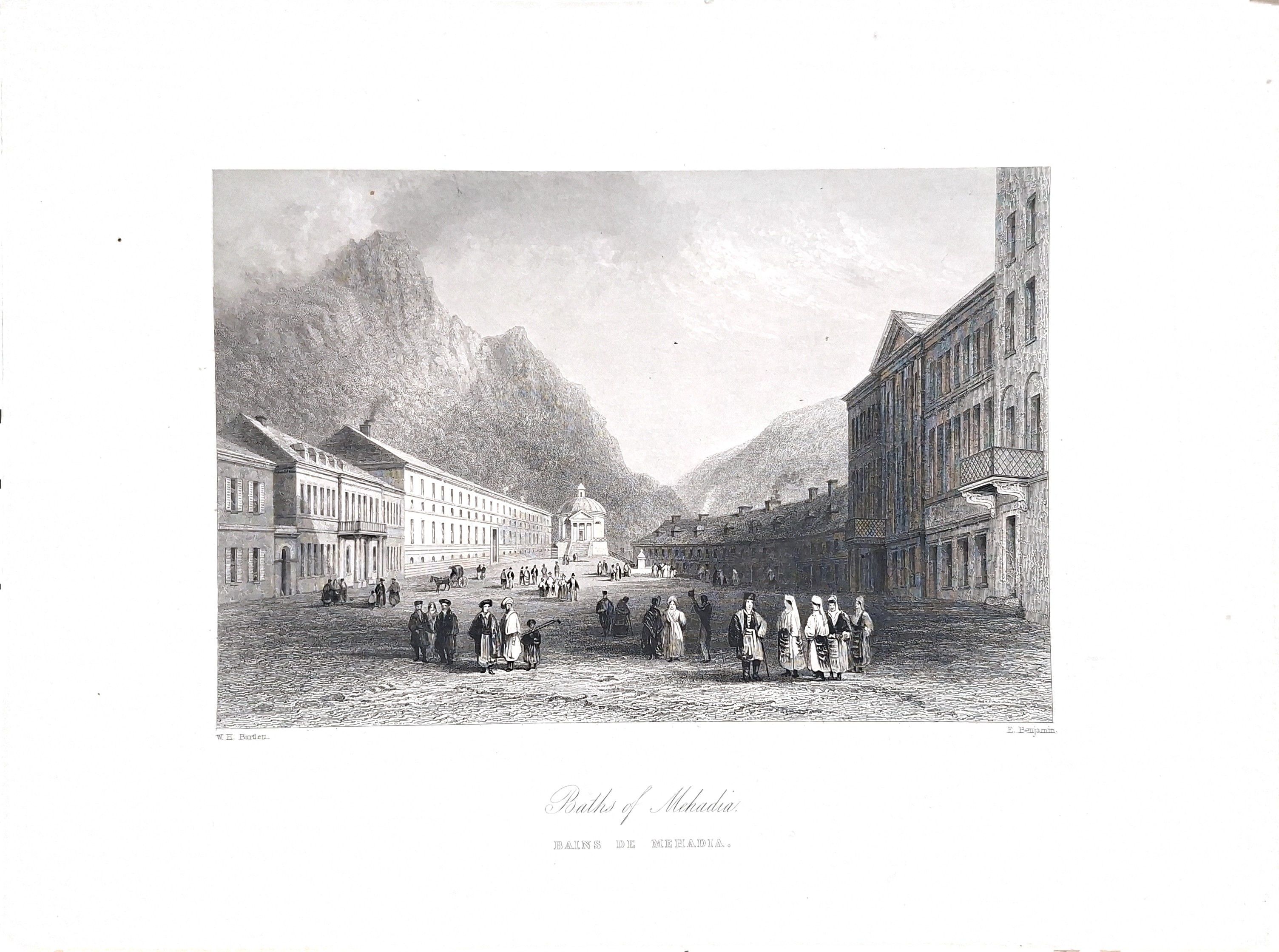
Bartlett - Baths of Mehadia - 1840
Description
Overview of the “Baths of Mehadia” Engraving
The steel engraving “Baths of Mehadia” (drawn by William Henry Bartlett, engraved by E. Benjamin, and published around 1842–1844 in The Danube: Its History, Scenery, and Topography) depicts the famous thermal spa resort known today as Băile Herculane in the Cerna River valley of Romania.
🎨 Key Details of the Engraving
• Subject: A picturesque view of the terrace and buildings of the Mehadia thermal baths set against the dramatic, steep mountains of the valley.
• Figures: The scene is animated with local figures and visitors dressed in 19th-century regional attire walking near the bath structures.
• Setting: Highlights the spa infrastructure nestled along the Cerna River, which had grown into a fashionable destination for travelers across the Habsburg Empire seeking the thermal waters’ reputed healing properties.
• Medium & Publication: Created as a steel-plate engraving, featured in Bartlett’s widely circulated travelogue on the Danube.
Current State of the Mehadia Baths (Băile Herculane)
The historic buildings and terraces depicted in William Henry Bartlett’s 1842 engraving (the historic center around Hercules Square and the thermal valley) are currently in a severely degraded but critically transitioning state, heavily scarred by decades of post-communist neglect and subsequent grassroots rescue efforts. The primary structures from that era—most notably the Neptune Imperial Baths (Baia Neptun)—have transformed from the bustling, fashionable resort of the 19th century into one of Europe’s most prominent examples of architectural decay and heritage preservation.
🏛️ Current Condition & Legal Limbo
• Property Disputes: Following the fall of communism in 1989, the historic thermal complex was privatized into a tangled web of conflicting private ownership and legal disputes between local authorities and investors.
• Severe Neglect: Because of this long-lasting legal gridlock, full-scale municipal restoration was blocked for decades. Left abandoned, the buildings suffered from extensive water infiltration, theft, and vandalism.
• Structural Collapses: The grand structures suffered partial roof and ceiling collapses in 2019 and 2021.
• Endangered Heritage: In 2022, Europa Nostra officially listed the Neptune Baths as one of Europe’s 7 Most Endangered Heritage Sites.
🛠️ Civil Society Interventions (The Herculane Project)
The buildings still stand today largely due to the intervention of volunteer architects, specialists, and activists who formed the Herculane Project:
• Emergency Safety Works: Since 2017, volunteers have cleared hundreds of cubic meters of rubble by hand, constructed structural scaffolding, and installed protective temporary roofing to halt immediate collapses.
• Physical Visuals: While the interior remains closed to the general public due to safety hazards, the exterior facades are heavily scaffolded. The area currently serves more as an atmospheric, melancholic open-air museum rather than an active spa.
🔄 National Integrated Pilot Project (2026–2030)
The resort is currently entering a critical turning point to reverse its decline:
• National Integration: Băile Herculane has been integrated into a national pilot project for integrated restoration.
• Future Roadmap: Backed by state initiatives, this program aims to finally untangle the structural, financial, and legal obstacles that have plagued the valley, laying down a roadmap to comprehensively restore the historic center over the coming years.
Date
1840 ( undated )
Dimension
Picture size approx.: 11 x 16 cm
Author
William Henry Bartlett (1809–1854), an eminent British artist celebrated for his detailed topographical steel engravings.
Comments