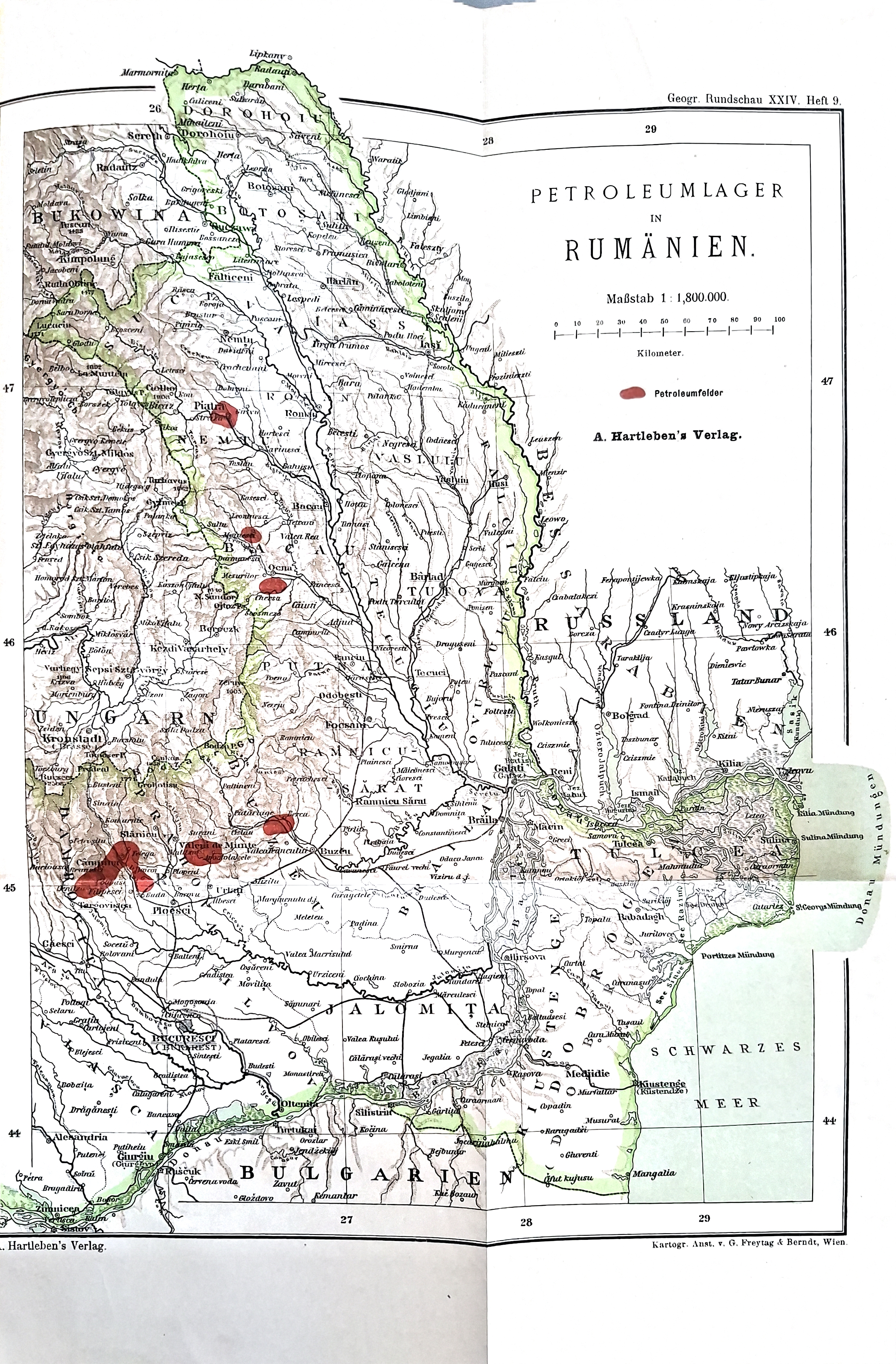
Title
Die Petroleumlager în Rumänien
Description
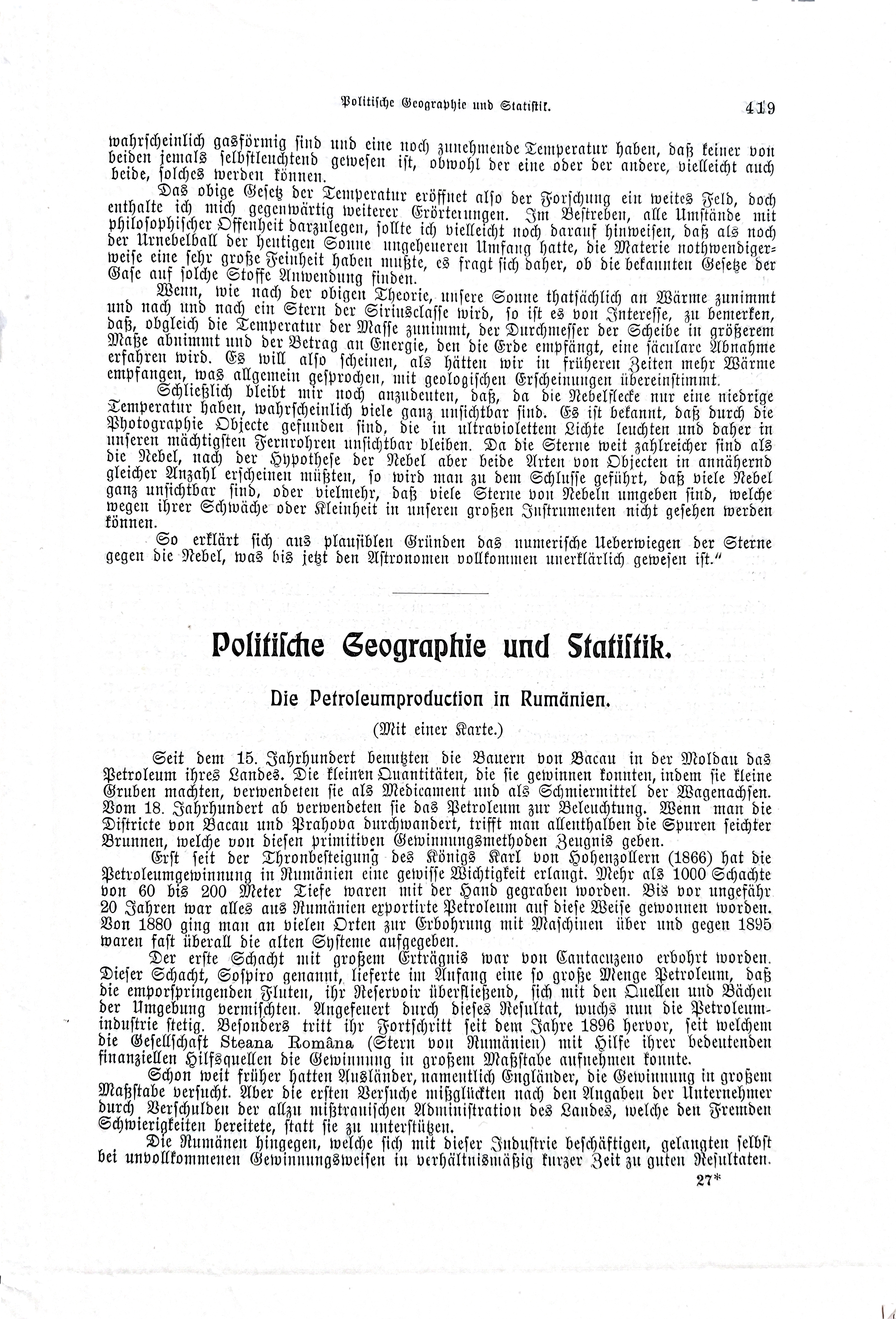
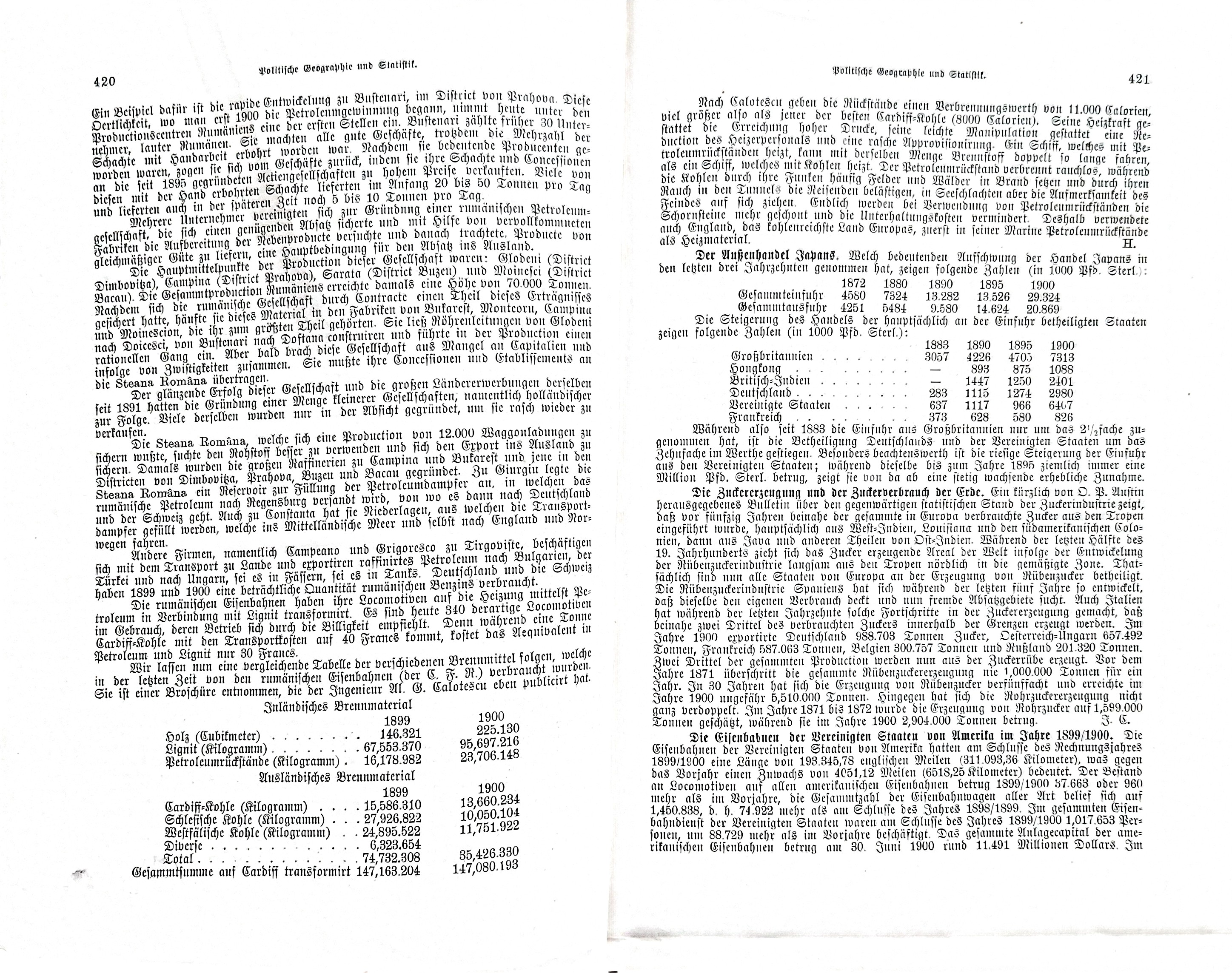
“Die Petroleumlager in Rumänien” (The Oil Deposits in Romania) article, published in Vienna on pages 419-422 of the 1902 volume of Deutsche Rundschau für Geographie und Statistik, serves as a comprehensive geographic and economic overview of Romania’s booming oil industry at the turn of the 20th century. The core elements covered in the article include:
- Geological & Geographical Distribution
The text maps out the primary petroliferous zones stretching along the foothills of the Carpathian Mountains. It focuses on the distinct oil-bearing structures of the following regions:
• Prahova District: Highlighted as the powerhouse of production, specifically detailing emerging industrial hubs like Câmpina and Buștenari.
• Bacău District: Discussed both for its modern yield and its historical significance, noting that primitive hand-dug oil pits (brănie) had been operated by local peasants here for centuries.
• Buzău and Dâmbovița: Examined as regions with vast, untapped potential undergoing rapid exploratory drilling.
- The Technological Transition
A central theme is the industrial revolution occurring within the Romanian oil fields. The article describes the shift from primitive hand-dug wells (which could only reach shallow depths) to modern mechanical drilling methods (such as the Canadian and hydraulic boring systems). This technological leap allowed companies to tap into deeper, highly pressurized oil strata, drastically increasing output and leading to frequent, spectacular oil gushes (erupții).
- Economic and Statistical Growth
The author provides rigorous statistical data reflecting Romania’s ascent on the global stage. By 1900–1902, Romania had risen to become the third-largest oil producer in the world, trailing only the United States and the Russian Empire. The article details: • The exponential growth of crude oil extraction volumes. • The expanding domestic refining capacity, particularly the factories built near Ploiești. • The infrastructural challenges, emphasizing the critical need for specialized pipelines and export terminals at the Black Sea port of Constanța to efficiently supply Western European markets.
- Foreign Capital and Legal Framework
Finally, the piece analyzes the socio-political climate shaping the industry. It touches upon the influx of foreign capital (primarily German, Dutch, British, and French investments) that funded the expensive machinery. It also mentions the impact of the Romanian Mining Law of 1895, which altered property rights regarding underground resources and opened the door for large-scale corporate concessions.
Date
1902 ( undated )
Dimension
Approximately cm. Scale 1:1 800 0000.
Condition
Folded map into journal.
Author:
Prof. Dr. Friedrich Umlauft (1844–1923) was a prominent Austrian geographer, cartographer, ethnographer, and educator. He was a highly influential figure in Vienna’s academic and cultural circles during the late 19th and early 20th centuries
Artile:
Comments