Title
Rohbock - Feldioara, Marienburg - 1864
Description
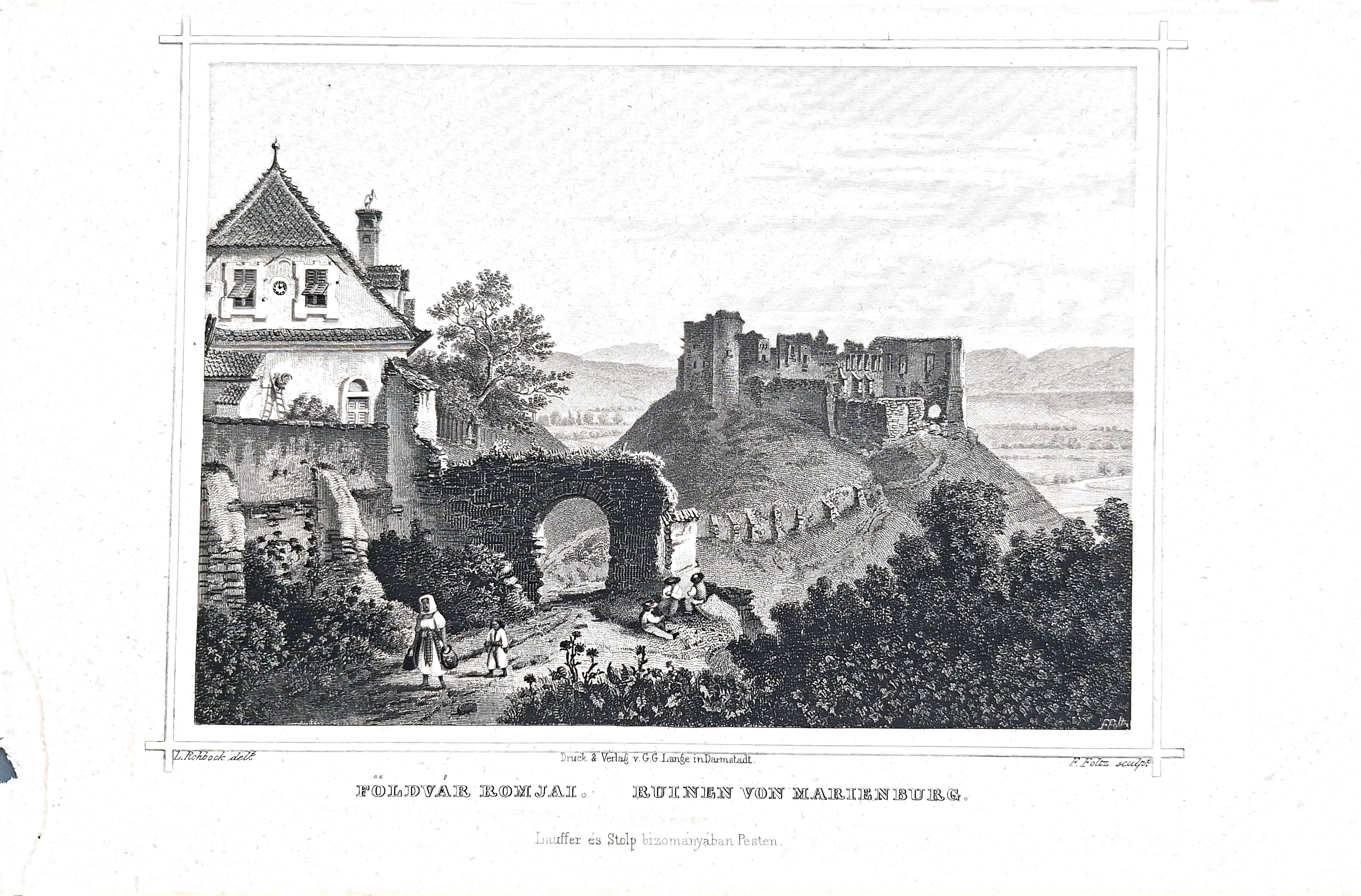
Published around 1864, “Ruinen von Marienburg” is a classic 19th-century steel engraving after a drawing by landscape artist Ludwig Rohbock and engraved by Friedrich Foltz. It depicts the historic fortress ruins of Marienburg (Feldioara) in Transylvania.
Artwork Overview
Title: Ruinen von Marienburg (Földvár romjai) Artist / Delineator: Ludwig Rohbock (1820–1883) Engraver: Friedrich Foltz Publication Year: Circa 1864 Medium: Steel engraving on paper Subject: The medieval Teutonic stronghold of Feldioara (Marienburg) in Transylvania
Visual Elements
Left Foreground: A prominent two-story estate building features traditional shuttered windows and a high-pitched tiled roof. Central Foreground: A dirt path cuts through dense shrubbery, leading toward a crumbling stone archway.Human Figures: Local peasants dressed in traditional attire are scattered along the path, including a woman carrying buckets and a small group resting near the arch. Midground Hill: The medieval fortress ruins sit atop a central mound, showing collapsed brickwork and hollow window bays. Background View: A vast valley landscape opens to the right, stretching toward a range of low, distant mountains under a light sky.
The Feldioara Fortress (historically known by its German name, Marienburg) has a layered architectural evolution that spans over 800 years. The structure went from a crusader outpost to a heavily fortified Saxon peasant citadel, before falling into the romantic ruins captured in Rohbock’s 19th-century engraving.
Teutonic Knights Foundation (1211–1225)
Establishment: The fortress was founded on a strategic 20-meter-high hill overlooking the Olt River by the Teutonic Knights, who were brought into the Burzenland (Țara Bârsei) by King Andrew II of Hungary.Initial Architecture: Recent archaeological excavations confirmed that the knights built a solid stone defensive system, including an exceptionally thick 2-meter enclosure wall made of quarry and river stones. This initial complex served as their regional headquarters and was named Marienburg in honor of their patron saint, the Virgin Mary.
Transition to a Peasant Citadel (14th–15th Century)
Saxon Customization: After the Teutons were expelled in 1225, the local Transylvanian Saxon community took custody of the fort, expanding it into a communal refuge (peasant citadel). Interior Layout: Within the oval-shaped curtain wall, they added storage rooms along the western perimeter to harbor villagers and protect provisions during sieges. A stone-lined communal water well and a large bread oven with a circular hearth were established inside the courtyard. Cistercian/Monastic Ruin: Following the knights’ departure, a short-lived monastery operated inside the walls. The ruins of this church layout—consisting of a rectangular hall and a semicircular apse—remained a permanent archaeological footprint in the center of the inner courtyard.
Renaissance Fortifications (16th–17th Century)
Defensive Upgrades: To keep pace with evolving artillery tactics, the fortress underwent major structural upgrades. The perimeter wall was raised to between 6 and 7 meters high and was reinforced with defensive features like embrasures and sloped pitch holes. The Four Towers: The oval defensive ring was bolstered by four distinct masonry towers: The West Tower: The largest and historically best-preserved tower, which served as a primary defensive command post. The East Tower: Tied directly to defensive living quarters. The North Tower: Heavily modified to serve as an observation post. The Gate Tower: Serving as the reinforced, heavily guarded main entryway.
Destruction and Contemporary Rebirth
Decline into Ruin: By the 18th century, the fortress had lost its strategic military purpose and became a simple storage site for the community. Abandonment and a series of earthquakes eventually left it a hollowed-out shell. This exact stage of skeletal, romantic decay is what Ludwig Rohbock observed and documented in his 1864 engraving. Modern Restoration: The crumbling silhouette shown in the print remained untouched until a massive, comprehensive reconstruction project took place between 2013 and 2017. Architects utilized historical documents and 17th-century site plans to completely rebuild the perimeter walls and towers, restoring the fortress to its late-medieval structural form.
Date
1864 ( undated )
Dimension
Picture size approx.: 11 x 16 cm
Author:
Ludwig Rohbock (1824–1893) was a German artist, renowed for his detailed architectural and landscape depictions across Central Europe.
Comments