Title
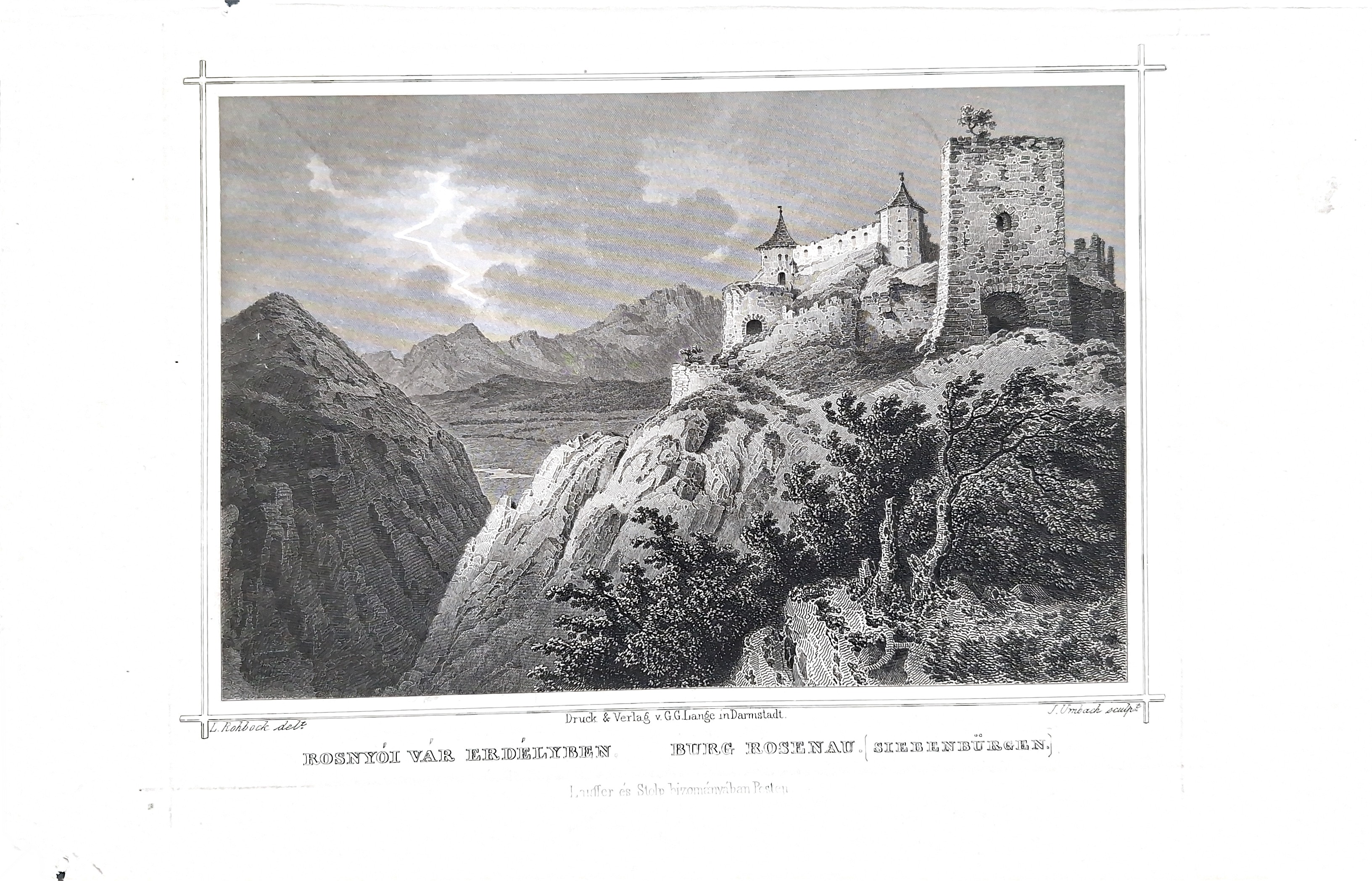
Rohbock - Rasnov, Rosenau - 1864
Description
Ludwig Rohbock’s 19th-century steel engraving of the Rosenauer Burg (Râșnov Citadel) depicts the medieval peasant fortress perched dramatically on a rocky hilltop overlooking the Transylvanian landscape.
Artwork Overview
Title: BURG ROSENAU. (SIEBENBÜRGEN) (ROSNYÓI VÁR ERDÉLYBEN) Artist / Delineator: Ludwig Rohbock (1820–1883) Engraver: Jonas Umbach Publication Year: Circa 1864 Medium: Steel engraving on paper Subject: The medieval peasant fortress of Rasnov (Rosenau) in Transylvania
Visual Composition
Elevated Fortress: The central focus is the massive stone fortification with its robust defensive walls, battlements, and watchtowers rising above the natural terrain.
Surrounding Landscape: The background frames the rolling hills and valleys of the Burzenland, showcasing the rugged topography that made the citadel an effective refuge.
Romantic Style: True to mid-19th-century romantic printmaking, the scene emphasizes historical grandeur, dramatic lighting, and fine architectural detail.
The history of Râșnov Citadel (known historically as Burg Rosenau in German) spans over 800 years, evolving from a crusader outpost into one of Transylvania’s most successful medieval refuges.
Foundation by Teutonic Knights (1211–1225)
First Fortification: The citadel’s origins date back to 1211, when King Andrew II of Hungary invited the Teutonic Knights to the Burzenland region to defend the southeastern border of his kingdom against the Cumans.
Wooden Structure: The knights built the initial fortification on the 150-meter-high limestone cliff, likely out of earth and timber, before being expelled from the region in 1225.
Rise as a Peasant Refuge (13th–14th Centuries)
Community Fortress: Following the departure of the knights, the Saxon colonists and local peasants took over and rebuilt the citadel using stone. Unlike royal castles, Râșnov was a “peasant citadel” (Bauernburg), built collectively by the inhabitants of the town below to serve as a refuge during invasions.
First Mention: The fortress is first officially documented in 1331 under the name Cheyn (and later as Rosnou in 1343) during a Tatar incursion.
Layout: The citadel was designed like a miniature medieval village, complete with over 30 houses, a school, a chapel, and workshops inside the walls, allowing hundreds of people to live there during extended sieges.
Military Triumphs and a Single Defeat (15th–17th Centuries)
Resisting the Ottomans: Due to its strategic position along the trade route linking Transylvania with Wallachia, Râșnov faced numerous Ottoman attacks. It successfully resisted major sieges in 1421, 1436, and 1441.
The Only Surrender (1612): The citadel fell only once in its entire history, in 1612, to Gabriel Báthory, the Prince of Transylvania. The defenders were forced to surrender not because the walls breached, but because enemy troops discovered and blocked the secret path to their water source outside the fortress.
The Legendary Well (1623–1640)
Securing Water: To prevent another disaster, the townspeople began digging a massive 146-meter-deep well directly through the solid rock inside the citadel.
The Legend: Local lore claims that two Ottoman prisoners were promised their freedom if they finished digging it. The grueling task took 17 years to complete, and the well ensured the citadel could survive completely self-sufficiently.
Decline and Modern Era (18th Century–Present)
Natural Disasters: The citadel’s military importance waned in the 18th century. A massive fire devastated the structure in 1718, followed by a highly destructive earthquake in 1802 that collapsed several towers.
Final Refuge: The last time the citadel was used as a place of refuge was during the 1848 Revolution, when local residents fled up the hill to escape marching imperial and revolutionary troops.
Abandonment: The fortress was abandoned later in the 19th century, eventually transforming into the romantic ruin that inspired Ludwig Rohbock’s engraving.
The Restored Citadel Today
Major Rehabilitation: Râșnov Citadel is currently undergoing an extensive multi-million euro municipal restoration project to repair structural damage from past centuries and ensure long-term preservation.
Current Access: Due to these major safety and rehabilitation works, the upper interior of the fortress is temporarily closed. However, the Fortress Garden remains open to the public.
Tourism: Visitors can access the grounds via an inclined elevator (funicular) from the town center. The garden offers panoramic lookouts over the Burzenland valley, and the site features a small museum. The local administration aims to fully reopen the interior by 2028.
Date
1864 ( undated )
Dimension
Picture size approx.: 11 x 16 cm
Author:
Ludwig Rohbock (1824–1893) was a German artist, renowed for his detailed architectural and landscape depictions across Central Europe.
Comments